4-6 months
- Development
- Relationship and Communication
- Safety
- Feeding
- Excretion, Sleep
- Health and daily life
- Playing and Learning
Breastfeeding
It is best to start breastfeeding as soon as possible after giving birth, usually within 30 minutes to one hour. It is also good to feed only breast milk for the first 6 months after birth and add solids after 6 months. Breastfed babies consume an average of 750-800 cc of breast milk per day from 1 to 6 months. However, it may vary from baby to baby.
Additional Information
- The Academy of Breastfeeding Medicine Korea: Breastfeeding Guidelines for Professionals, 2nd Edition
- La Leche League International. The Breastfeeding Answer Book
- Academy of Breastfeeding Medicine Korea: Breastfeeding after Birth
Expressing and storing breast milk
-
1. How to express milk by hand
Breast milk is often expressed to prevent breast engorgement or to store milk. Breast milk production requires a device such as a breast pump, but if you learn how to express breast milk by hand, you will actually produce more milk than with a breast pump. It may help to take a hot shower or apply a warm wet towel before expressing breast milk. First, massage your breasts to gather milk towards the areola, then express the milk using the “Mamat Technique.”
-
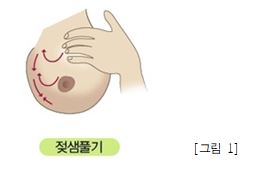
Unfold your palm and massage the outer part of the breast in a circular motion for a few seconds on each area [Figure 1].
-
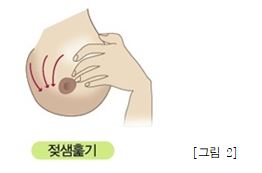
After massaging the entire breast, gently sweep from the upper part of the breast towards the nipple. Continuing this movement will relax your entire body and help your milk flow more easily [Figure 2].
-
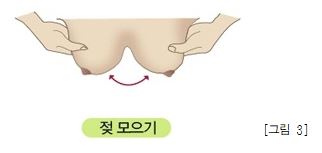
If you bend your chest forward slightly, gently hold your breast, and lightly shake it, milk will collect toward the areola [Figure 3].
- Repeat steps 1, 2, and 3 2-3 times.
- Express breast milk using the “Marmet Technique.”
-
Place your thumb on the upper part about 3cm away from the nipple and the remaining fingers on the lower part of the breast in a ”C” shape as shown in [Figures 4 and 5]. This hand shape is similar to pointing to the 6 and 12 o'clock hands on a clock. (Avoid covering the entire breast.)
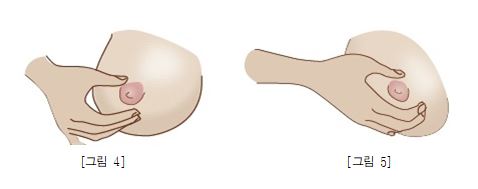
- Press your fingers straight towards your chest. Be careful not to spread your fingers.
- Use your thumb on the upper part and two fingers on the lower part to compress and empty the milk collected on the areola (reservoirs) while rolling in a circular motion. Be careful not to press too hard on the breasts and damage the breast tissue.
-
Repeat the above motions (hold with “C”-shaped fingers, push, turn, and squeeze [Figures 6, 7, and 8]) for 5 to 7 minutes. Repeat steps 1, 2, 3 2-3 times, and express breast milk using this technique for 3-5 minutes.
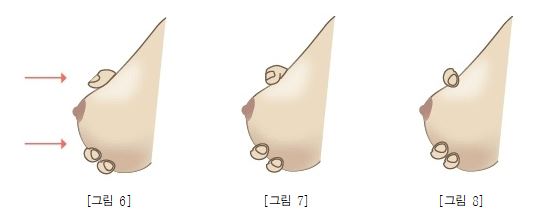
- Repeat steps 1, 2, 3 2-3 times, and express breast milk using this technique for 3-5 minutes.
- After emptying all the breast milk from one breast using the above method, use the other hand to empty the other breast. Once you master the above method, you will be able to empty both breasts in about 20 to 30 minutes.
-
Unfold your palm and massage the outer part of the breast in a circular motion for a few seconds on each area [Figure 1].
-
2. Using a breast pump
- Wash the part of the breast pump that comes into direct contact with milk with a special detergent, rinse thoroughly with cold water, place on a clean towel, and air dry.
- Wash your hands with soap and wash your breasts with clean water.
- Express breast milk using a breast pump.
- Store breast milk in a container (bottle, plastic container, or plastic bag) in portions of 60-120cc to make it convenient to thaw and prevent milk waste when the baby cannot drink a lot at once. Containers made of glass or hard plastic are suitable for long-term storage. However, plastic bags are recommended for short-term storage of up to 3 days, because there is a risk of contamination or leakage when stored for a long period of time.
- Record the date and amount of milk you expressed on the container containing your breast milk.
- Freeze expressed breast milk after cooling. If the amount of milk is small, cool it and store it in the refrigerator. When an appropriate amount has been collected, freeze it.(If the amount of cooled breast milk in the refrigerator is less than the amount of already frozen milk in the freezer, it can be mixed with the frozen milk and then re-frozen.)
- When thawing breast milk, take it out of the freezer 10 to 12 hours in advance, place it in the refrigerator, and then warm it in a container of warm water or under running water. You should not defrost breast milk in a microwave, because this can cause the milk to lose its immune components and burn your baby’s mouth
- When breast milk is thawed, the fat separates and floats to the top. Shake the container in a circular motion to re-mix.
- If there is any leftover thawed breast milk after feeding it to your baby, throw it away.
Tip!
- The best time to express breast milk is in the morning after a good night's sleep (when milk production is highest), between feedings, and when the baby has not emptied both breasts.
- If you are returning to work, plan the times you will express around the times you can do it at work, starting two weeks before you return.
How to store breast milk
| Room Temperature (25℃) | Refrigerated (0~4℃) | Separate Freezer Compartment in the Refrigerator | |
|---|---|---|---|
| Freshly expressed breast milk | 4~6 hours | 2~3 days | 3~4 months |
| Frozen breast milk after being thawed out | No storage allowed | Within 24 hours after thawing (when refrigerated) |
No refreezing allowed |
-
1. Things to keep in mind when storing breast milk
- The immunity components of breast milk are better preserved when refrigerated rather than frozen.
- When stored frozen, the fat content of breast milk breaks down after 3 months, so do not store it for longer than that.
- Breast milk expands when frozen, so you should not fill the storage container or breast milk storage bag fully.
- When storing in the freezer, be sure to seal the storage container or breast milk storage bag to prevent contamination.
- Enter the date and time of storage for each pack/container.
- Collect only breast milk you express in one sitting in one storage bag to prevent contamination.
- Store only the amount your baby will eat at one time.
-
2. Thawing
- Frozen milk can be thawed naturally in the refrigerator the night before feeding (requires 24 hours) or thawed in lukewarm water below 37°C, then boiled over warm water before feeding.
- Do not heat in the microwave as they destroy the nutrients in breast milk.
-
3. Precautions
- It is recommended that thawed breast milk be fed immediately after being thawed out, rather than stored at room temperature.
- If you want to store thawed breast milk, you can refrigerate it and feed it within 24 hours.
- When breast milk is thawed, the fat content will rise to the top, so you need to shake it well before feeding.
- Thawed breast milk should not be refrozen.
- Discard after feeding.
Please check the following websites or resources for more information:
- The Academy of Breastfeeding Medicine Korea: Breastfeeding Guidelines for Professionals, 2nd Edition
- La Leche League International. The Breastfeeding Answer Book
- The Academy of Breastfeeding Medicine Korea: Breastfeeding for Working Mothers
- MotherSafe: How to Store Breast Milk Safely
Formula feeding
- Babies typically feed 6 to 8 times in a 24-hour period, but there is no set amount or frequency they should eat as it varies depending on the baby. Some babies may have shorter intervals between feedings, while others may have longer intervals. They should be fed whenever they are hungry. Below is a general guide to formula feeding.
- When your baby is 3 to 6 months old, they will need about 120cc of formula per kg of body weight. So, a 5-month-old baby weighing 7 kg can consume 840 cc of formula per day. Even if your baby wants to eat more, make sure the daily feeding amount does not exceed 960cc. Record how many times your baby feeds each day.
The information on feeding amount by age below is only a guide and may not fit your baby perfectly.
| Category | Number of Feedings | Time Interval | Feeding Amount | Notes |
|---|---|---|---|---|
| Newborn Baby | 8-12 | 2-3 hours | 50-100 cc per feeding |
|
| 1-4 months | 4-10 | 2-4 hours | 100-200 cc per feeding |
|
| 5-6 months (Stage 1 of weaning) |
4-6회 | 4-6회 Daytime |
1회 160~200cc (800-1,000 cc per day) |
|
| 7-8 months (Stage 2 of weaning) |
3-5 | 5-6 hours Daytime |
160-240 cc per feeding (700-800 cc per day) |
|
| 9-11 months (Stage 3 of weaning) |
2-3 | Morning Afternoon Evening |
600-800 cc per day |
|
| 12-24 months (Final stage of weaning and regular food) |
2 | Morning Afternoon |
400-600 cc per day |
|
(Source: Korea Health Promotion Institute, Secrets of Breastfeeding Success)
Stage 1 of weaning(5-6 months)
Understanding Stage 1 of Weaning
Give your baby a small taste of juice before feeding them solids to let them know there are other foods besides breast milk/formula. This will make it much easier to start solids. If you prepare solids and simply feed it to your baby around 5-6 months old, they may reject it, so start slowly. For babies preparing to wean, liquid food that can be easily swallowed like soup is suitable.
The soup should be thin like water (rather than thick like oatmeal) so make it easier for your baby. Once they grow used to solids, you can add a vegetable at a time to the light soup, such as radish, carrot, pumpkin, or potato. It is best to allow the vegetable to taste its own flavor without adding salt or sugar.
Stage 1 Weaning Purpose and How to Wean
- The reason to wean early is to supplement any lacking nutrition from breast milk or formula alone. However, the main purpose is to give your baby a varied palate and introduce them to a variety of foods and also teach them how to use a spoon. This is the first stage of weaning and the first food other than milk, so heed caution from the start. The most suitable baby food is made with enough water to be easily swallowed. As a rule, start with one spoonful a day and gradually increase the amount depending on how your baby takes it. If your baby doesn't like the solids, you can start by putting the spoonful in their mouth once and then taking it out. When adding new foods, introduce one a day and observe for a few days to see if there are any adverse reactions.
- Choose a time when the baby is in a good mood and you have free time to feed them solids. 10 a.m. generally works. It is recommended to maintain a daily schedule by setting a similar feeding time every day.
- 30-80g of solids, number of times to feed the baby: 800-1000cc of breast milk or formula (160-200cc per feeding), number of feedings: 4-6 times, feeding interval: 4-6 hours.
- When you wean your baby, feed solids first when they are hungry, and supplement with breast milk.
Available Foods and Consistency
| Available Foods | Consistency | |
|---|---|---|
| Grains | Rice, glutinous rice, potatoes, sweet potatoes | 10 times thin rice gruel / Thickness like soup |
| Meat, fish, eggs, beans | Beef, egg yolk, peas, kidney beans | Served in broth or finely ground |
| Vegetables | Zucchini, cabbage, broccoli, carrots, spinach (from 6 months) | Served as juice or finely ground |
| Fruits | Bananas, apples, pears | Served as juice or finely ground |
※It is still too early to consume milk and dairy products, fats and sugars, seasonings, etc.
How to make: Rice gruel
-
Ingredients: 10 g soaked rice, 100 cc water
- ① Grind the soaked rice finely in a blender.
- ② Put the soaked rice and water in a pot and boil over high heat while stirring with a spatula.
- ③ Reduce the heat to low and simmer the ingredients from ② while stirring until the rice is cooked through.
- ④ Sift ③ out through a fine sieve to remove any remaining solids.
-
Precautions
- ① Introduce one food at a time.
- ② Add a new food every 4 days, and at 8 months of age, add one every 2-3 days.
- ③ Fruit juice should not be given before 6 months of age.
- ④ Begin giving meat from 6 months of age.
References