4-6 months
- Development
- Relationship and Communication
- Safety
- Feeding
- Excretion, Sleep
- Health and daily life
- Playing and Learning
1. How to Use Infant/Car Seats Safely
Car seats should be selected according to the growth stage of the infant or toddler and installed in the correct direction.
- Car seats must be installed in the back seat of the vehicle.
- Both left and right rear seats can be equipped with 3-point seat belts.
- If a car seat is installed in the passenger seat of a vehicle, the infant or toddler may be subjected to strong impacts from an airbag that deploys in the event of a traffic accident, which can threaten the life and physical safety of the infant or toddler.
- Car seats must be installed facing the correct way. When transporting a baby weighing less than 10 kg and less than 12 months old in a car, the rear-facing car seat must be installed. Even after the baby's first birthday, a rear-facing car seat is safer until the age permitted by the car seat manufacturer.
- Car seats must be securely fastened to the vehicle seat to minimize shaking according to the installation instructions. A loosely attached car seat can move violently in the event of a traffic accident, causing secondary impacts to infants and toddlers.
- The backrest and headrest must be installed correctly.
- The backrest must be installed at a tilt angle appropriate for the infant or toddler's growth stage.
- The headrest must be adjusted to a height that sufficiently supports the head of the infant or toddler. Car seats with head restraints that are lower than the infant's body do not adequately protect the infant's head and neck in the event of a traffic accident.
2. Using Baby Carriers and Baby Wraps/Sings Safely
- When purchasing a baby carrier, check for safety certification.
- Make sure that the product manual or video is easy to understand and provides a safe way to use the product.
- When shopping for a carrier, take your baby with you and ask the salesperson to show you how to hold your baby and adjust them to fit safely.
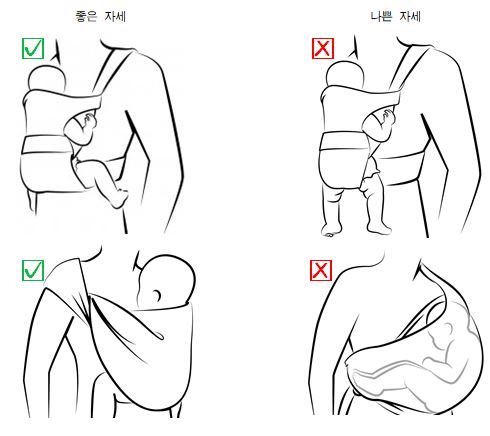
- When using a carrier, your baby should be able to move their head, arms, and legs freely.
- Make sure the carrier cloth does not go into your baby's face and that your baby can see out of the carrier.
- Make sure you can put on and take off the carrier without assistance.
- You must be able to put your baby into and lock the carrier without assistance.
- You can also practice with a doll or teddy bear before using it on your baby.
- Wear comfortable walking shoes and make sure the road surface is even.
- Avoid using the carrier on very hot days as an adult's body temperature and the carrier can raise the baby's body temperature. Instead, use a stroller.
- Be particularly careful when putting on and taking off a carrier as this is the time when most accidents occur. If possible, you can do this with the help of another person or by sitting on the floor.
- When bending over or leaning while carrying a baby in a carrier or sling, hold on to something safe, such as a pole.
- When cooking, do not hold your baby in front of you as this may cause burns.
- If the baby carrier is not used correctly, there is a risk of suffocation because young babies cannot move in a dangerous position that would break their airway.
3. Using a Podaegi
- Podaegi, a Korean traditional style of baby carrier, is becoming more known overseas. Some say when a baby is carried on a caregiver’s back, the baby will feel their body temperature and see, hear, and experience the same things, which has a positive effect on the formation of attachment and the baby’s development. In the past, there was a misconception that carrying a baby on your back would cause the baby's legs to bend, but it can actually help prevent developmental dysplasia of the hip (DDH).
- Carrying a baby on your back is more convenient so you don't have to worry, and your hands are free to do housework.
- Although many modern baby products are used, it’s a good idea to purchase and use commercialized podaegi that are improved versions of the traditional podaegi.
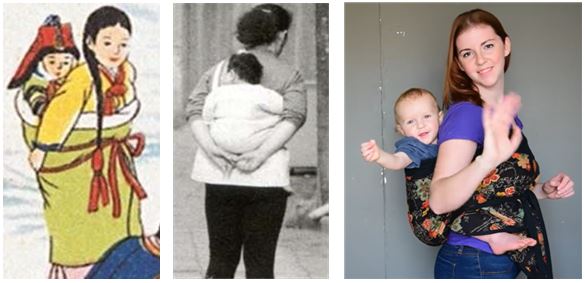
Figure. Women wearing podaegi(from left to right: A woman wearing podaegi in an old material
a woman wearing podaegi in modern Korea, teaching American mothers how to use podaegi)
(Source : Han Jae-hwi, Lee Eun-jin, Types and Transition of Traditional Korean Baby Carrier Podaegi, Fashion Business 2020;24(1):60-74., How to use a podaegi? https://www.youtube.com/watch?v=IG3gmCycv3M, EBS Documentary Prime. Old Future. The Secret of Traditional Parenting, https://www.youtube.com/ watch?v=lwzQ6UxCoTc)