Getting Pregnant
- The Menstrual Cycle
- Ovulation, Fertilization and Implantation
- Gender Determination
- When to Have Sex for Pregnancy
Ovulation
Ovulation is when a mature egg is released from the ovary into the fallopian tube around the middle of the menstrual cycle. The day when the egg is released is called the “day of ovulation.”
If your periods are regular, you can predict your day of ovulation and fertile window in advance.
Ovulation typically occurs about 14 days before a menstrual period starts, and the fertile window includes the 5 days before expected ovulation, with the highest probability occurring in the 2-3 days leading up to and including the day of ovulation.
e.g.) If you have a regular 30-day menstrual cycle and your most recent period started on April 25,
- Next period due date : May 24
- Approximate ovulation date : May 10(by deducting 14 days from May 24)
- Approximate fertile window : May 5 ~ May 13
Even if your menstrual cycle isn't regular, there’s no need to worry.
There are several ways to determine your ovulation date.
You can check for ovulation through menstrual history, basal body temperature(BBT), blood progesterone measurement, endometrial tissue biopsy, luteinizing hormone(LH) surge tests, and ultrasounds.
- 1. Menstrual history
If your menstrual cycle is regular(at 28 days), ovulation is generally estimated to occur around Day 14, which is about 14 days before the start of your next period.
- 2. Basal body temperature(BBT)
When ovulation occurs, the corpus luteum releases the hormone progesterone, which causes a slight increase in BBT. You can see ovulation with the BBT chart. However, there is a disadvantage in that there may be cases where ovulation occurs without a rise in BBT, and ovulation may occur even when the BBT chart indicates that ovulation has not occurred.
- 3. Blood progesterone measurement
When a blood sample is taken from the mid-luteal phase and the progesterone level in the sample exceeds a certain level, ovulation is considered to have occurred.
- 4. Endometrial tissue biopsy
An endometrial tissue biopsy showing a secretory phase 2-3 days before the approximate period confirms that ovulation has occurredAn endometrial tissue biopsy showing a secretory phase 2-3 days before the approximate period confirms that ovulation has occurred.
- 5. Ultrasound test
The follicle grows approximately 2 mm per day and then suddenly grows just before ovulation and then ovulation occurs.
- 6. Luteinizing hormone(LH) surge test
When there is a surge in LH after the explosive secretion of female hormones, ovulation always occurs after a certain amount of time(usually 12-36 hours). A LH surge test, whether via a blood or urine test, can predict ovulation. You can use an ovulation test kit to predict the timing of ovulation by using urine.
(Source : Korean Society of Contraception and Reproductive Health)
How to Use an Ovulation Test Kit Correctly
- When to use
Determine by calculating your menstrual cycle. Test once a day at the same time starting 2-3 days before ovulation.
- How to use
Use the test at a convenient time of day for you. However, it must be done at the same time(First-morning urine should be avoided.)
Use it immediately after opening.
Urinate on it directly or dip it in a cup according to the instructions.
Lay it flat and wait for 3 to 5 minutes. - Results
If the test line is as dark as or darker than the control line, you are likely to ovulate.
※ The ovulation test kit is an in vitro diagnostic medical device. When purchasing an ovulation test kit, check whether it is a product approved and certified as a medical device by the Ministry of Food and Drug Safety.
A variety of symptoms may appear around the time of ovulation.
Two days before ovulation begins, clear, stretchy cervical mucus, similar to egg whites, appears.
You may experience ovulation pain, which feels like a stabbing pain on one side of your abdomen. Thanks to the increase in hormone secretion, you may experience increased appetite and sexual desire.
You may also experience mood swings, etc. These symptoms do not occur in all women, and each woman's health can affect the symptoms that occur around ovulation.
References
Fertilization
Sperm that enter the vagina swim with their long tails and reach the fallopian tubes.
The lifespan of an egg is approximately 18 to 24 hours after ovulation. However, sperm have a longer lifespan and remain alive for several days after ejaculation.
Accordingly, when the egg is about to move into the fallopian tube and a sperm reaches the egg, or while the sperm is still alive in the fallopian tube and the egg moves down, fertilization occurs. Of the hundreds of millions of sperm ejaculated, usually only one combines with the egg.
From the moment of fertilization, the fertilized egg forms a thick membrane on its surface to prevent other sperm from entering.
Implantation
The fertilized egg continues to divide and moves toward the uterus.
It takes about 3 to 4 days after fertilization for the egg to reach the uterus. During that time, the fertilized egg will have divided into 12 to 58 cells, which is called the morula stage.
From this point on, division occurs again and the embryo enters the blastocyst stage. Through the blastocyst stage, the embryo is divided into the part that grows into the fetus and the part that helps the fetus grow, such as the placenta, umbilical cord, amniotic fluid, and amniotic membrane.
The fertilized egg that arrives at the endometrium melts the surface of the endometrium, enters it, and gradually becomes enveloped. This is called implantation. It usually takes about a week from fertilization to implantation.
If you experience vaginal bleeding within 6 to 12 days after conception, it is likely implantation bleeding, which can occur when the pregnant embryo implants in the uterus.
Contraception and Menstruation Research Society
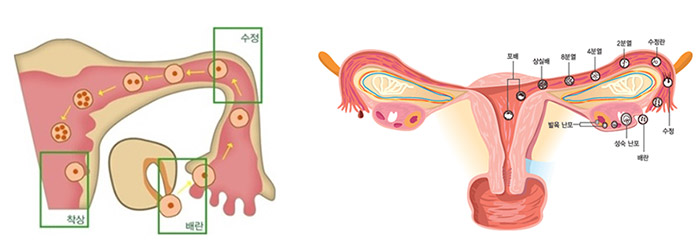
(Source : Contraception and Menstruation Research Society)