Preterm Baby
Pay close attention to the development of your preterm baby.
-
1. Keeping a developmental diary
Look at developmental milestones and keep track of what your baby achieves each month.
By writing a daily developmental diary, you can learn important information and provide it to medical personnel when you visit the pediatric department, the psychiatric department, or an infant development center. -
2. What Can My Baby Do? – Developmental Milestones by Age
연령별 발달 과정-연령, 운동, 적응, 언어, 사회적행동 테이블 Corrected Age Exercise Response Language Social Actions ~4 weeks Bends their limbs. Has active reflexes (Moro, rooting, sucking, etc). Turns their face to light in view. Responds to voices. Prefers human faces. 1 month Lifts their chin and turns their head left and right when placed face down. Looks at people. Follows moving objects. Starts to smile. Flinches in response to voices. 3 month Raises their head and chest with their arms stretched out for support when placed face down. Tilts their head slightly in a seated position. Approaches an object while watching it but cannot grasp it. Moves their hand when looking at a toy. Places their hands on the middle of the body. Listens to the sound of music. Makes an “ah” sound. Social reaction time increases. 4 month Lifts their head and chest so that their head is in a vertical position when placed face down. Keeps their head straight when held and raised from the lying position to the sitting position. Reaches a hand for an object, grabs it, and brings it to their mouth. Laughs out loud. Likes food when they see it. 7 month Able to sit on their own when you help them sit. Tries to crawl or crawls on their knees and arms. Stretches out their legs to support their body when you help them stand. Transfers objects between hands. Grabs a small object with hook-shaped fingers when they see it. Makes vowel sounds of three or more syllables. Prefers mom. Likes looking in the mirror. Reacts to others’ emotions. 10 month Sits up alone. Crawls around. Stands up with support. Holds something between the thumb and first finger. Pronounces repeated consonant sounds (such as mama and papa). Plays peekaboo, hand-clapping, or bye bye games. 12 month Stands up alone. Walks on their own. Picks up pill-sized objects between their thumb and first finger. Opens their hand and releases the object they were holding when asked. Says a few other words other than mama and dada. Plays simple ball games. Stays in posture when being dressed.
One, two, one, two! Exercises for preterm babies to help them grow
-
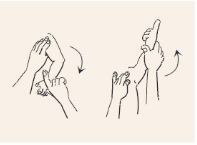
1. Raising each of your baby’s arms up
With your baby lying flat, hold their shoulder with your hand to prevent it from rising, hold their wrist with the other hand, and raise your baby’s arm above their head with the elbow straight.
-
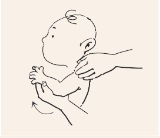
2. Placing each of your baby’s arms inward with their arm out to the side
With your baby lying flat, hold their shoulder with your hand to prevent it from rising, hold their wrist with the other hand, and bend their arm across the torso toward the opposite arm.
-
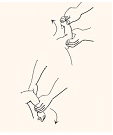
3. Rotating each of your baby’s arms
With your baby lying flat on their back, extend their arms out to the side at about 90 degrees from the torso, bend their elbow, and lift their arm up, and then lower them down by holding the wrist.
-
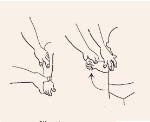
4. Stretching each of your baby’s arms out to the side
With the baby lying flat on their back, hold their shoulder with one hand to prevent it from rising, and hold their wrist with the other hand, extending the arm out to the side away from the torso.
-
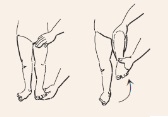
5. Bending each of your baby’s legs
With your baby lying flat, hold their upper buttock area with one hand and support their knee with the other hand, then lift your baby's leg up.
-
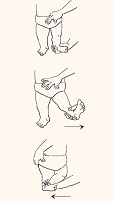
6. Spreading and closing each leg to the side
With your baby lying down, hold their pelvis with one hand and grab the heel with the other. Spread their leg to the side and then place one leg against the other.
-
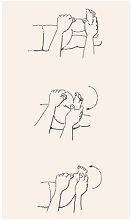
7. Bending your baby’s pelvis and knee, and rotating their leg
With your baby lying down, bend their hip joint and knee joint to about 90 degrees. Hold their upper knee with one hand and grab their heel with the other hand. Their Turn their heel outward and then inward so that their the knee moves inward.
Cognitive, behavioral, or emotional problems that may arise in preterm babies
Long-term studies on cognitive decline, attention problems, Autism Spectrum Disorder (ASD), and depression in preterm babies have shown that preterm babies, compared to full-term babies, have an average IQ 12.9 points lower and are 2 to 4 times more likely to develop Attention Deficit Hyperactivity Disorder (ADHD). Additionally, very low birth weight (VLBW) infants were more commonly diagnosed with ASD at an average age of 5 years.
Autism Spectrum Disorder (ASD) is characterized by deficits in social communication and interaction, including reduced social and emotional reciprocity, nonverbal communication, and restricted/repetitive behaviors and interests. Early screening starting at 18 months of age and early intervention treatment has been shown to be effective.
Therefore, it is essential to receive treatment at the follow-up observation period after discharge.
Learning while playing
-
1. What is play to a baby?
Play is an important part of parenting and a great way to build parent-child relationships. Babies learn to communicate and interact through play, which are important for their brain development. Letting your baby know that you enjoy interacting with them gives them a sense of security, which can then be used as a to form relationships with others.
During play, you should avoid exposure to media such as TV, computers, and digital devices until 18 months of corrected age. Until this time, babies need to develop cognition, language, motor, and social-emotional skills through creative play and interaction with their parents. In addition, to promote neuro-development, the World Health Organization (WHO) recommends that a baby under 1 year of age spend several active times a day, including at least 30 minutes of tummy time, while lying face down, and that inactive time, such as in strollers, high chairs, or being carried on a parent's back, be limited to less than 1 hour per day. -
2. Recommended games by age
연령별 추천 놀이-연령, 내용, 발달놀이도구 테이블 Corrected Age Content Developmental Play Tools Newborn baby - Give lots of physical contact (stroking, hugging, massaging, etc.).
- Let your baby see your face up close.
- Place a baby mobile over the crib.
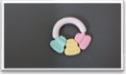
- Choose a brightly colored toy (such as a rattle) and move it so your baby's eyes follow it.
- Have your baby touch different textures with their hands by exposing your baby to them. (Cloth books, sensory dolls, etc.)


1~3 months - Talk to your baby, read to them, and sing to them.
- Hang up a mobile (black and white mobile, color mobile, mobile with bright and contrasting colors) and have your baby look at it.
- Respond to sounds and expressions by imitating what your baby does.
- Help your baby learn to self-soothe by letting them suck on their fingers.
- Strengthen your baby's neck and back muscles by placing them on their stomach for tummy time.
- Lay your baby on their back on the floor and encourage them to move their feet and kick their legs (by using a baby gym)
- Toys that babies chew and play with can be helpful.

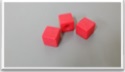
4~6 months - Encourage your baby to bring hands to their middle by doing exercise.
- Peekaboo is a helpful tool for developing rudimentary object permanence skills.
- Make your baby play with toys such as rattles or toys with colorful pictures.
- Keep toys close to your baby so they can reach them or kick them.
- Help your baby grasp toys or rattles.
- Make your baby listen a variety of sounds by using a music machine, bell, music box, or toy that makes noises.
- Try shaking the rattle slightly outside the baby's sight to get the baby to turn their head toward the sound.
7~9 months - Encourage your baby to imitate you, particularly, following traditional motions such as peek-a-boo, hand-clapping, bye-bye, touching their cheeks, or opening and closing their fists.
- Make your baby play games of searching for hidden objects.
- Plastic containers or plastic spoons that can be easily found at home can be used as toys.
- Sit your baby on your lap and read a book. If appropriate, make sounds that match pictures. e.g.) If it's a picture of a cow, you may say 'moo'; if it's a picture of a cat, say 'meow'; if it's a picture of a car, say beep beep’.
- Playing with blocks of different sizes and colors is helpful.
- If your baby drops a toy on the floor, pick it up and return it. This helps your baby learn cause and effect activities.
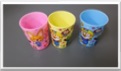
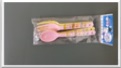
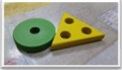
10~12 months - • Encourage your baby to grasp small objects with their thumb and index finger, explore objects in various ways such as shaking, hitting, and throwing, and put objects into containers.
- • Describe specifically what your baby is seeing.
- • Make your baby learn words such as “no” with shaking a head, words like “mom” and “dad” and exclamations like “uh-oh”.
- Toys that can be played with while being hit such as xylophones, drums, and bottles, push-or-pull toys such as balls, large plastic carousels, pop-out toys, goblin boxes, and toys with buttons or knobs are helpful.