Newborns
Breastfeeding
Feeding your baby colostrum
- Colostrum is breast milk that begins to be produced in the third trimester of pregnancy and lasts for 2-3 days after delivery, in which it turns into mature milk after. Compared to milk, colostrum contains more than four times more protein, minerals, and fat-soluble vitamins, including essential amino acids and immunity, which protect babies from diseases. In addition, it supplies nutrients, reduces the symptoms of hypoglycemia, and makes it easy to excrete meconium to prevent jaundice.
- Newborn babies are naturally clumsy at sucking, swallowing, and breathing, but the amount of colostrum is very small. Even if the baby accidentally swallows it, there is less risk of the milk getting into their ear (the middle ear) or lungs. Once your baby gets used to the sucking mechanism for their first 2-3 days, your milk will flow. Even if the amount of milk increases, the baby will be able to suckle well without choking or milk going into the middle ear.
- Since the amount of colostrum is small, the baby will suck it frequently, which stimulates the breasts to produce mature milk more quickly and prevents engorgement. It also helps in uterine contractions by promoting the secretion of oxytocin.
Tip!
Breast milk should not be restricted, and colostrum should be given whenever the baby wants it. As such, it is very important to put the mother and the baby in the same room after birth.
The spouse’s role during breastfeeding
The spouse’s/father's role in breastfeeding is also important. Breastfeeding is something that both mother and father do together. As mothers learn how to breastfeed, it is important for fathers to have knowledge, enthusiasm, and support of breastfeeding as well. If a mother finds breastfeeding difficult, her spouse can give her confidence and help her overcome the difficulties. This may help mother continue breastfeeding for longer.
Caring for breastfeeding mothers
New mothers who are breastfeeding for the first time have a lot to deal with. It is normal to feel anxious, tired, and physically uncomfortable, but happy as well. Here are some ways a spouse can help a breastfeeding mother :
- Spouses should find out what mothers need while they breastfeed. This includes bringing water, offering a pillow if needed, or removing any distractions, such as siblings, family members, or pets that can make it difficult for the baby to concentrate on breastfeeding.
- Spouses should bring the baby to the mother for nighttime feeds and help put the baby back to sleep. Even if they just do this during the night, it can be a huge help.
- Spouses should wait, even if the mother does not feel close to the baby at first. She may be tired and distracted due to breastfeeding, holding the baby, or putting them to sleep.
- Encourage the mother to drink and eat as much as she wants and make sure there is enough food at home. Breastfeeding can make a mother very hungry or thirsty.
- As the father, you should take on as many household chores as possible, such as cooking or laundry. When you reduce the burden of housework on the mother, she can focus on breastfeeding without stress.
The bond between fathers and babies
- Some say that the bond between breastfed babies and fathers is weaker than that of formula-fed babies and fathers. As most babies breastfeed than sleep, there is no time for fathers and babies to spend together. So how can the bond between breastfed babies and dads be fostered in this type of situation?
- Even dads who only have a short time with their babies at home have plenty of opportunities to bond with them. When a mother breastfeeds her baby, the dad can touch the baby's hands or body parts and talk to the baby. Alternatively, the dad can bond with his baby by changing his or her diaper after the mom finishes feeding on her one breast, burping him or her, putting him or her to sleep after finishing feeding on the other breast, and giving them a bath.
How to breastfeed
-
1. Period
It is recommended to start breastfeeding as soon as possible after giving birth (within 30 minutes to 1 hour). It is also recommended to feed only breast milk for the first 6 months after birth and add baby food after 6 months. The World Health Organization (WHO) recommends exclusive breastfeeding (EBF) until age 2 and continued breastfeeding thereafter for as long as both mother and baby wish.
-
2. Number of feedings
- Allow the baby to breastfeed whenever they want. Newborn babies need fed approximately 8 to 12 times a day, or every 2 to 3 hours. Let them suckle on one breast for 10 to 15 minutes before switching as this is an appropriate length of time.
- Newborns breastfeed in irregular intervals. It is better to breastfeed whenever your baby is hungry rather than following a timed schedule. The more often you feed, the more they will come out.
- During the neonatal period, you should breastfeed from both breasts. By about one week of age, a baby should wet at least 6 to 8 cloth diapers (or 5 to 6 disposable diapers) with urine and have 3 to 4 diapers showing at least one 100 won-coin sized poop to be considered feeding appropriately.
-
3. Position
Any breastfeeding position is acceptable as long as you and the baby are comfortable. Make sure that the baby's head, shoulders, and hips are aligned straight, and the baby's face faces your chest. Sit comfortably back on the sofa, place your feet on the footrest so that your knees are higher than your hips, and cradle your baby, pulling their head toward your chest. After a caesarean section, you can breastfeed comfortably by holding your baby on your side like holding a football or by lying on your side. Regardless of the breastfeeding position, you should avoid pushing the baby's head because this would cause the baby to tilt his or her head back and away from the breast.
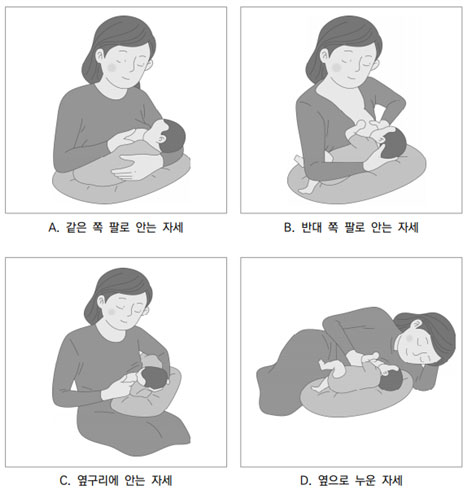
For more information about breastfeeding positions, please visit the following websites :
How to burp your baby
- Place the baby on your lap, place one hand on the rear upper chest or on the lower jaw and then use the palm of the other hand to sweep or pat the baby's back from the bottom up.
- Place your baby on your shoulder so that the baby's upper body rests on it. Then, support your baby's bottom with one hand, and stroke or pat the baby's back with the other hand.
- Lay the baby on your lap and stroke or pat the baby gently with your palm.
- Because a baby's stomach is immature, the baby may burp a small amount of milk, unlike adults, but there is no need to worry. However, if your baby vomits profusely like a fountain, you should consult a doctor. When burping your baby, place a clean towel underneath for any spew. After feeding on one breast, burp your baby, change the diaper if it is wet, and then feed on the other breast. If your baby is breastfed, there is no need to worry if they do not burp well.
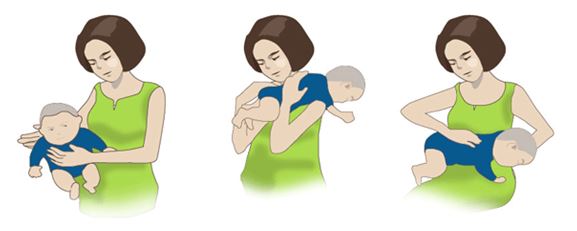
Find more information on the following websites :
- Media Library : Media Library: Pregnancy and Childbirth - Breastfeeding Video
- Korean Society of Obstetrics and Gynecology : Breastfeeding Guide, Breast Massage Guide for Breastfeeding
Tip!
Keep a breastfeeding diary
If you’re breastfeeding for the first time, it can be helpful to keep a record by creating a chart like the one below, just like you would in the hospital.
| Date | Time | Feeding Time - Right/Left Breast | Urination | Stool()Color) | Note(In Case of Vomiting) |
|---|---|---|---|---|---|
| 9/1 | AM 07:00 | 15/20 | * | ||
| 9/1 | AM 09:00 | 20/20 | Vomited slightly | ||
| 9/1 | AM 10:30 | 10/25 | * | ||
| 9/1 | AM 12:30 | 20/10 | * | ||
| 9/1 | PM 02:00 | 10/20 | |||
| 9/1 | PM 03:30 | 25/5 | * | ||
| 9/1 | PM 05:00 | 10/20 | * | ||
| 9/1 | PM 07:00 | 25/5 | * |
- 0 to 2 months of age : 6 to 8 pees/day, 3 to 5 stools/day
- After 2 months of age : 5-6 pees/day, 2-3 stools/day
- Number of pees and stools may vary slightly.
How to maintain a sufficient breast milk supply
To maintain a sufficient breast milk supply :
- Breastfeed your baby as soon as possible after birth.
- Do not give milk or water to your baby.
- Breastfeed your baby 8 to 12 times a day, and express milk if your baby cannot completely empty your breasts.
- Feed your baby whenever they want, without time restrictions.
- Prevent nipple chafing/pain and use a comfortable breastfeeding position.
- Drink enough water to starve off your thirst. You can also drink as much water, juice, soup, milk, etc. as you like. However, stress from excessive water intake can actually reduce breast milk secretion, and it is best to avoid drinking too much caffeine, such as coffee, chocolate, tea, and soft drinks. However, one cup a day is okay.
- Get enough rest. Avoid distractions while breastfeeding by doing things like listening to soft music in a quiet environment or putting away your phone.
- Find ways to relieve and reduce your stress.
- If you have difficulty breastfeeding, find out which institutions (hospitals, public health centers, population health and welfare associations, etc.) can help you.
- Get support from your family. It is especially helpful to get help with housework from your husband or parents.
For more details, check out the websites below :
Breastfeeding and food
-
1. What is the best way to eat while breastfeeding?
Postpartum mothers need an additional 500 calories per day while breastfeeding. A balanced diet is important, including fresh vegetables and fruits. Foods rich in calcium and iron are especially important.
- Foods rich in iron : Lean meat, liver, kidneys, egg yolks, fish, prunes, green leafy vegetables, dried fruits, nuts, clams, oysters, oatmeal, peas, etc.
- Eat plenty of fresh fruits and vegetables because vitamin C helps iron absorption. Caffeinated beverages, such as coffee and soft drinks, interfere with iron absorption.
- Foods high in calcium : Low-fat yogurt, milkshakes, low-fat milk, ice cream, cheese, eggs, tofu, dried pollack, anchovies, sesame seeds, spinach, radish greens, broccoli, kale, and other green leafy vegetables
- Calcium from vegetables has a low absorption rate. Vitamin D is needed for calcium intake, so get some sun exposure (morning sunlight; about 20 minutes of daily sunlight exposure is sufficient).
- Make sure you’re getting enough fluids. If you feel thirsty before and during breastfeeding, drink water, juice, milk, soup, etc. Carry water with you when going out with your baby, especially during the summer months, to avoid getting thirsty. If your urine is concentrated or you are constipated, increase your fluid intake.
-
2. Foods to avoid during breastfeeding
There are no specific foods that breastfeeding mothers should avoid. However, if you have an allergic reaction to a specific food, you may need to avoid that food and any related foods. You should avoid alcohol, cigarettes, coffee, caffeinated tea, and soft drinks while breastfeeeding. However, mothers who enjoy caffeinated things, such as coffee, chocolate, or soft drinks, can have one cup a day. However, make sure to check if your baby has trouble sleeping or is fussy after you drink these drinks. Drinking alcohol can decrease breast milk production, disrupt your baby's sleep, and interfere with mom and baby interactions. It is recommended to limit alcohol consumption to one glass or less and breastfeed four hours after drinking. Taking dietary supplements, including herbal products, can affect your baby.
Tip!
Nowadays, dioxin is becoming a serious problem and global concern. Some shocking reports showed that dioxin was found even in breast milk. Make sure to avoid meat, fish, fruits, and vegetables contaminated with pesticides or air pollutants. Rinse fruits and vegetables thoroughly in running water and remove the skin of fish or the fat of meat before eating, as these areas tend to accumulate chemicals. However, there is no need to stop breastfeeding.
- Korea Disease Control and Prevention Agency National Health Information Portal : Successful Breastfeeding
- The Korean Committee for UNICEF (KCU)
Formula feeding
How to feed formula
Even when feeding formula, you need to hold your baby comfortably and close to your side. When you place the nipple of the bottle against your baby's lips, the baby will open their mouth and begin to suck. Make sure to feed your baby with the bottle upright to avoid swallowing air from the bottle. If your baby stops sucking or drinks half of the formula, carefully remove the bottle, burp your baby, and then feed again.